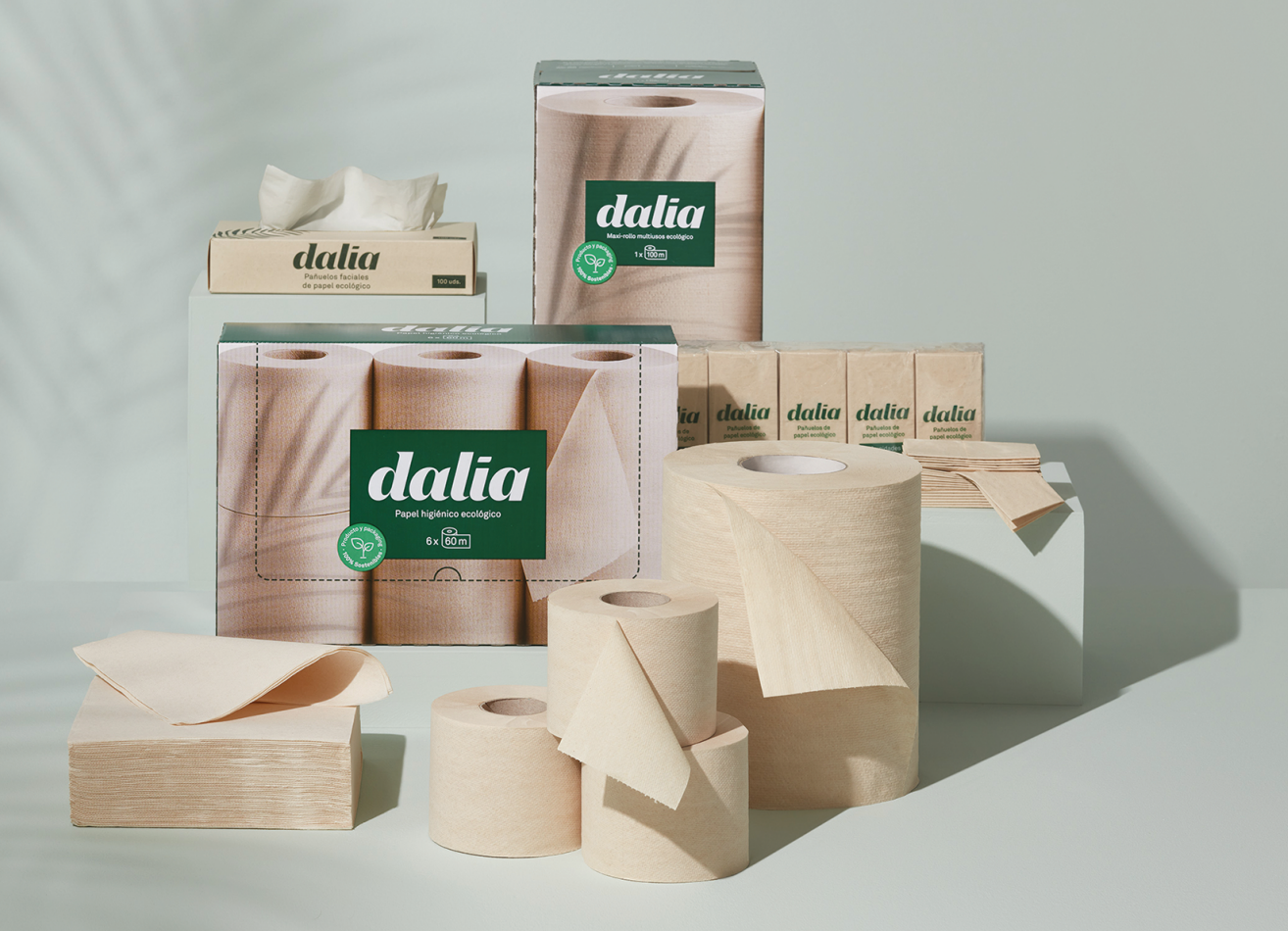
The ‘Dalia’ toilet paper: a holistic vision of sustainable tissue products
LC Paper is a family company founded in 1881, now led by the fifth generation. Its core market is the production of parent reels that serve as the raw material for middle-market paper converters: historically in the kraft/MG category and, more recently, also in the tissue segment. In a competitive, commoditized industry with intense global trade, the company recognised the need to develop a strong differentiation in order to remain competitive. Doing so in product attributes is complex, so it chose to do it through the processes and values behind them: abating carbon emissions through innovative energy solutions, choosing creative packaging formats and eco-designing the products with a life cycle perspective. The Dalia toilet paper is the landmark of these learnings: six toilet paper rolls made from unbleached pulp in collaboration with Ence, where both sides of the supply chain coordinated to develop a pulp with lower environmental footprint (Naturcell Zero). Produced with renewable electricity and steam from biomass and biomethane, and packaged in a recycled folding board box similar to the cereal boxes we all know, which allows for an aggressive palletisation and improves transportation efficiency. By thinking about impact – which implies rethinking all the vertical areas where the product can consume resources; where from, how many – instead of sustainability, which might tell only part of the story, we take a holistic approach to the sustainable transition of tissue products.
Potential future developments
While the Dalia project offers a conceptual approach at tissue products which goes beyond cherry-picking one area of sustainability and committing to it, but rather looks at the whole picture, it is still far from being a neutral impact product: there are still some remaining life cycle emissions, which we chose to offset by now, but in the future should be abated; while there is also some water consumption due to non-negligible process evaporation. It could even be argued that the horizon might not actually be zero impact but positive impact: the aspiration to regenerate ecosystems, capture emissions and contribute to the local communities. In spite of these future challenges, we believe widening the scope of sustainability to encompass all the areas where those essential products might have an impact that has the potential to be abated or reversed is a bold step.
Current contribution
This project is a good example of how cross-collaboration between different levels in the supply chain can take the environmental credentials of forest-based products further. On one hand, the pulp producer could not unilaterally change the parameters of the raw material without agreeing with the papermaker, which had to make changes to the processes on its side to adapt to the new, more sustainable specifications of the pulp. On the other hand, by looking inside our own paper and cardboard industry we can find existing, competitive and sustainable solutions to challenges like non-compostable film packaging; and by thinking further – including the downstream stages of our product’s life cycle – we can enable emission reductions even beyond our industrial footprint, as we make possible a significantly improved use of space in trucks and containers due to the higher stackability of the selected packaging materials.