Biobased, biodegradable biopolymers from paper process water.
Often, the paper industry finds itself in direct competition with the makers of plastic packaging, but the Dutch recycled solid board manufacturer, ESKA, which is part of RDM Group, is creating a sustainable material that can be used for packaging.
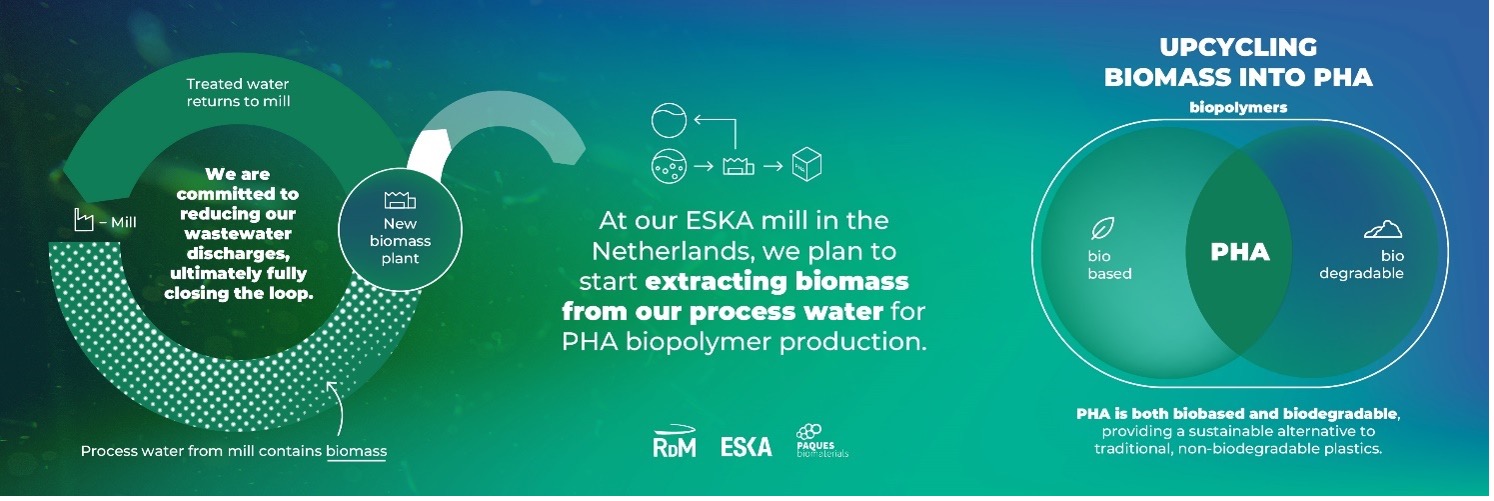
Organic material contained in the process water from the manufacturing of ESKA board at its Hoogezand plant in north-east Netherlands will be used to produce a biopolymer by fellow Dutch company Paques Biomaterials. This biopolymer, called PHA, has the double benefit of being both biobased and biodegradable.
The opportunity arises because many producers of paper – particularly for corrugated cardboard packaging – are using an increasing amount of starch to help maintain the strength of their products. This starch (much of which comes from potatoes) ends up dissolved in the process water of manufacturing mills that use recycled cardboard as a raw material. The ESKA board production plant in the Netherlands is one such mill and with its state-of-the-art closed-loop water system the increased starch content has been affecting operations.
Finding a more circular solution
RDM Group, under the leadership of the Dutch team, has worked in cooperation with Paques Biomaterials over the past 10 years to resolve the challenges and has developed a more circular solution. In a new plant, the process water will be fermented and aerated in a series of biological reactors to form a specific type of biomass that will then be dried into a powder. The treated water will be returned to the mill. The drying process will use heat energy captured from the bioactivity itself – and any excess energy can be fed back to the mill.
As well as being suitable for food and beverage packaging, PHA has the potential for use as a biodegradable barrier coating or adhesive in RDM Group’s own recycled cartonboard products, increasing the circularity of the Company’s operations.
Potential future developments
- The commercial adoption of PHA is already expanding across multiple industries:
- Packaging: Films, containers, and coatings that require compostability and food safety.
- Single-use Items: Cutlery, straws, and shopping bags, providing alternatives to banned single-use plastics.
- Agricultural Films: Mulch films that degrade in soil, obviating the need for collection and disposal.
- Biomedical Devices: Sutures, scaffolds, and drug delivery systems, leveraging biocompatibility and controlled degradation.
Expansion into high-performance barrier materials to be used in the European Paper industry
By fine-tuning bacterial strains and fermentation conditions, it is possible to tailor PHA polymer properties for demanding applications:
- Engineering Plastics: Development of PHAs with improved strength, flexibility, and temperature resistance for use in automotive, electronics, and durable goods.
- Composite Materials: Blending PHAs with natural fibres or nanoparticles to enhance mechanical performance and open doors to new markets
- Further enhancement for recyclable fibre-based materials with non-plastic coating, more circular and more recycling friendly
Behind the long term vision of RDM Group with its network of 8 mills currently across Europe will have a unique positioning to apply PHA barrier solutions derived from its own water systems lies the integration of the biomaterials back into the innovative cartonboard, recycled products, being self-sufficient covering the demand of effective barriers for oils and grease as well as oxygen (main barriers) with a non-plastic, biodegradable solution that is recycling friendly.
Current contribution
RDM Group (ESKA division) together with Paques Biomaterials is sending the biomass powder to be taken away and turn it into an estimated 2,000 tons a year – or 70 truckfuls – of PHA, or polyhydroxyalkanoate. PHA is similar in look, feel and performance to plastics produced from fossil fuels. Because it comes from a renewable, biobased resource and is both biodegradable and compostable, PHA offers the possibility of a sustainable alternative to traditional, non-biodegradable plastics.
The global shift toward a circular and sustainable economy is redefining industrial landscapes across Europe, with the bioeconomy playing a pivotal role. At the heart of this transformation are innovative companies such as RDM Group’s ESKA and Paques Biomaterials, both of which are making significant strides within the Netherlands and, by extension, across the European Union (EU). Their latest developments in biopolymer technology and circular material processing are aligned with the EU’s Green Deal, Circular Economy Action Plan, and Bioeconomy Strategy.
The Netherlands offers a fertile environment for bio-based innovation, with strong links between companies, research agencies, and government initiatives. ESKA and Paques Biomaterials are active participants in national and EU consortia, contributing with knowledge, technology, and demonstrator projects that inform broader policy and industry practice:
- Microbial Biopolymer Production: Process involving bacteria to convert organic waste streams into PHAs.This process uses resources that would otherwise be considered waste, contributing to the circularity pillar of the bioeconomy.
- Waste Valorisation: By turning municipal, agricultural, and industrial waste into high-value biopolymers.
- Decarbonisation and Sustainability: PHAs biodegrade completely in natural environments, reducing the burden of plastic waste and microplastics in land and marine ecosystems. The company’s biopolymers are crafted to meet stringent EU sustainability criteria, supporting the Union’s ambitions for a plastics-free, low-carbon future.
- Market Applications: PHAs are being developed for a wide range of uses, from agriculture (mulch films, plant pots) to packaging (films, trays, and coatings), single-use items, and even medical applications.

Contact
Krzysztof Krajewski
krzysztof.krajewski@rdmgroup.com